


Send Message
Privacy statement: Your privacy is very important to Us. Our company promises not to disclose your personal information to any external company with out your explicit permission.

Dongguan City Jiubei Compressor Parts Co., Ltd
Critical temperature reference for ZAKF screw compressors: Normal operating temperature should be 80°C‑90°C, when temperature reaches 105°C, the control panel will trigger an alarm, 110°C will force automatic shutdown for machine protection.
For equipment running in Saudi Arabia, UAE, Egypt, Nigeria, Kenya, Algeria and other high‑temperature zones, the compressor baseline heat load is much higher than that in temperate regions. Even normal load operation can push the temperature close to the alarm threshold. Once cooling system efficiency drops slightly, overheating faults will occur immediately. If your unit hits 105 °C alarm or 110 °C emergency shutdown, stop continuous running immediately and follow the step‑by‑step inspection workflow below.
Image A Image B Suggestion: Prepare real‑site photos for reference. : Internal cabinet photo, circle and mark thermostatic valve location on oil circulation piping. : External cabinet photo, circle and mark oil cooler / cooling radiator core assembly.
Record real discharge temperature from HMI controller, total running hours, and current ambient temperature (key for Middle East & Africa sites). • Ventilation check: High outdoor temperature in desert regions easily causes hot air recirculation in the compressor room. Confirm no blocked air intake or accumulated hot air; keep room ventilation unobstructed. Ambient temperature must stay below 40°C for stable operation. • Oil level inspection: Check the lubricant sight glass to ensure oil level is between min‑max marks. Low oil level severely reduces heat dissipation capacity and triggers high temperature faults under extreme heat. • Oil quality check: Dark, foamy, or milky oil indicates degradation or water contamination. High ambient heat accelerates oil aging, so deteriorated oil must be replaced immediately.
The thermostatic valve is the core component regulating lubricant circulation path. It controls whether oil bypasses or flows through the oil cooler according to oil temperature, directly determining the cooling efficiency of the whole machine. Operation steps:
Common failure reminder: Long‑term high‑temperature operation in Middle East and African regions easily produces oil sludge, which blocks the thermostatic valve spool and causes failure.
The oil cooler (radiator core, marked in Image B) undertakes the core heat dissipation work. In Middle East and North African industrial sites, frequent sand dust and floating fibers easily block cooling fins, greatly reducing heat exchange efficiency and causing overheating. Operation steps:
After completing the three steps above, restart the compressor and monitor the operating temperature. If the temperature still exceeds 95°C, check the oil filter, oil separator differential pressure, air filter blockage and temperature sensor calibration. Contact ZAKF technical support for professional diagnosis.
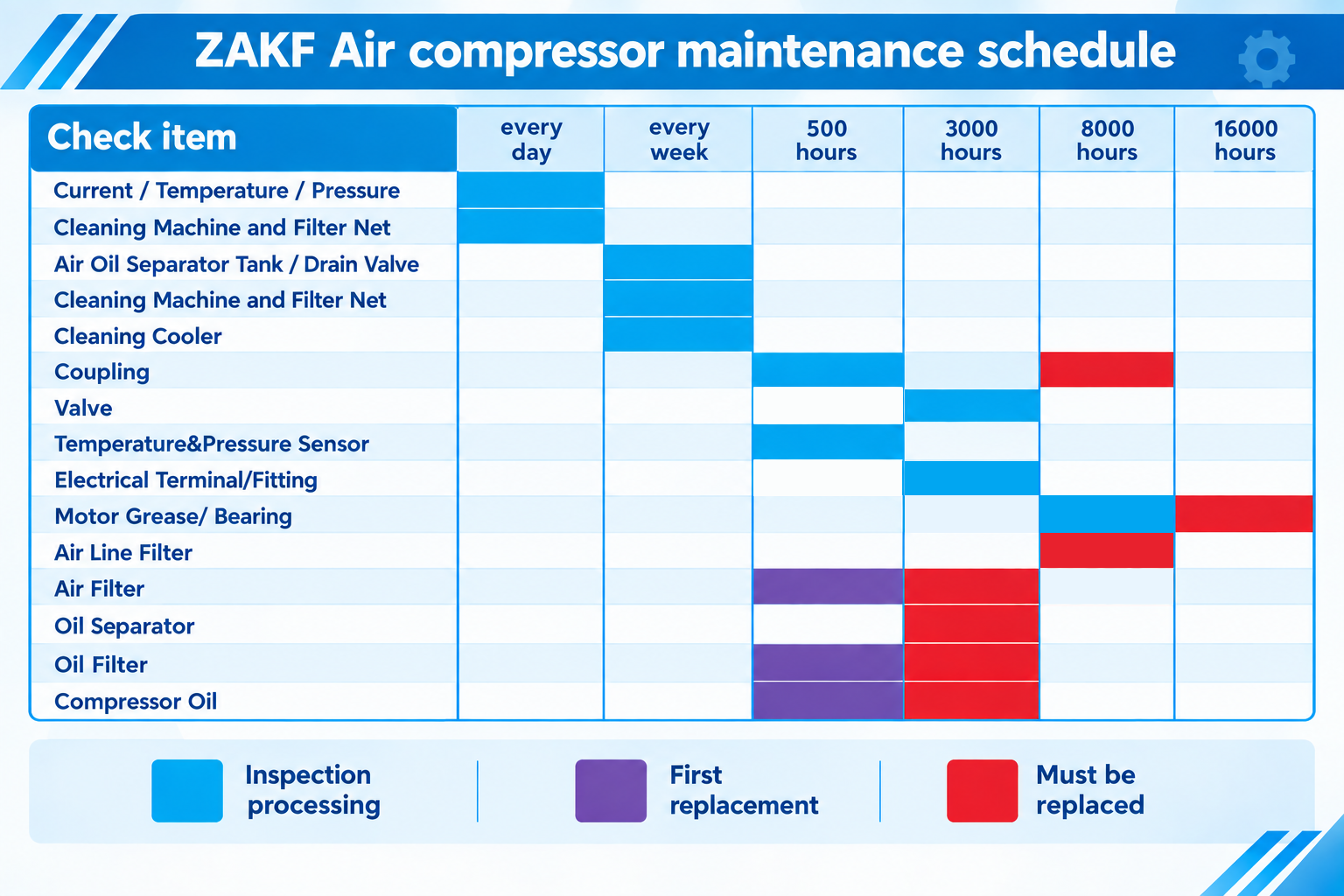
For equipment operating in Middle East, Africa and other high‑temperature, dusty harsh environments, the lubricant aging speed is 30%‑50% faster than normal conditions. It is necessary to strictly follow the shortened maintenance cycle below, and do not mix different grades of lubricants.
| Lubricant Type | Application Scenario | Standard Replacement Interval | Special Working Condition |
|---|---|---|---|
| ZAKF PAO‑4000 Synthetic Compressor Oil | General‑purpose for ZAKF fixed‑speed / PM‑VSD screw compressors | 4000 operating hours | 3000 h for high‑ambient‑temp (>35 °C) / dusty workshops |
| ZAKF PAO‑6000 Full‑Synthetic Compressor Oil | Heavy‑duty, 24/7 continuous operation | 6000 operating hours | 4500 h for harsh site conditions |
| First‑run oil (new machine break‑in) | New unit commissioning | 500 hours | Strictly follow break‑in cycle regardless of environment |
Supporting maintenance suggestion: Replace the oil filter synchronously when changing lubricant. Replace the oil separator element once differential pressure alarm occurs or the service cycle expires.
Aiming at the extreme high temperature and dusty characteristics of Middle East and African industrial parks, ZAKF summarizes targeted maintenance rules:
Q: Can I continue running the compressor when 105°C high‑temp alarm appears in hot seasons? A: Absolutely not recommended. Continuous operation under alarm status in high‑temperature environments will rapidly accelerate lubricant carbonization, cause airend wear and even seizure, resulting in high maintenance costs and long‑term production shutdowns.
Q: Overheating is fixed after cleaning the cooler, but it recurs after a few weeks? A: This is a common problem in Middle East and African dusty sites. It is necessary to check the air filter clogging degree, confirm whether the thermostatic valve is worn and stuck, and increase the frequency of cooling system cleaning and inspection.
This guide applies to all ZAKF screw air compressor series. Actual component layout varies by model. Please refer to the original official manual. For complex faults in special high‑temperature regions, please contact certified ZAKF regional service technicians.

September 17, 2026
Email to this supplier
September 17, 2026


Privacy statement: Your privacy is very important to Us. Our company promises not to disclose your personal information to any external company with out your explicit permission.
Fill in more information so that we can get in touch with you faster
Privacy statement: Your privacy is very important to Us. Our company promises not to disclose your personal information to any external company with out your explicit permission.